Showing posts with label Aegean Sea. Show all posts

Monday, June 17, 2013

Sailing the Aegean (REPOST)

My computer hard-drive crashed and burned 2 weeks ago so I now have a new computer complete with Windows 8. I'm still getting accustomed to that...it's slow going. When Matt set up my new laptop, he made my photo album from our sailing trip in Turkey in September 2007 the wallpaper and screensaver slide show. The pictures are bringing back wonderful memories, so thought I'd repost my original blog account of that adventure here.

Enjoy!

Sailing the Aegean
 
The Aegean Sea: Sun, sand, warm breezes and clear blue waters, or, as Homer  more accurately described it, "The wine dark sea." Throw in  some ancient ruins, modern cities, phenomenal food and a welcoming crew that  cater to your every need and that was our perfect sailing adventure in Turkey with Azure Odyssey (www.azureodyssey.com).
 
Us, on board the Azure Dolunay

Matt and I, along with our friends Todd, Donna, Nadine and Ted, started and  ended our adventure at the Su Hotel in the bustling seaside resort town of  Bodrum on the southwest coast of Turkey. We were picked up at the Bodrum airport by the hotel van for the 30 minute drive into town. Our excitement grew as we passed palm trees and resorts, crested the hill into  downtown Bodrum and wound our way through narrow streets and dark alleys. Our excitement changed to concern when our driver parked and we proceeded on  foot down a bustling, narrow side street and into a dark alley. Where was  he taking us? When we opened the gate into the courtyard of The Su Hotel (www.suhotel.net), we knew - paradise!
 
The Su Hotel is a group of beautiful, bright white Mediterranean-style  buildings just a few blocks from the waterfront, but hidden away from  everything by vine-covered walls. It’s an oasis of tropical vegetation - hibiscus, bougainvillea, golden trumpets and palm trees. The hotel cat  greeted us and led us into the main courtyard, where the invitingly lit pool sparkled and begged to be swum in. The buildings and rooms are  trimmed in bright, primary colors. Turkish mirrors, plates, pictures, amphorae and urns line the walls, enticing you to explore every nook and  cranny. The dining area is a large courtyard with comfy cushioned seats and benches around long white tables. The delicious aromas coming from the kitchen were fully matched by the great food that followed. The staff made us feel right at home, except Matt doesn’t get service and food quite this good at home!   
 
Matt taking photos of the Su Hotel courtyard and pool

There are great sites all around Bodrum. We explored the bazaar for spices, clothes, plates, tapestries and beautiful materials, pillow-covers and bedspreads.  Vendors sell fresh seafood along the waterfront, and there are loads of treasures to be found in little shops down all the twisty alleys. The bright, intricate designs of the pottery drew us into Vivaldi, a shop specializing in pottery and ceramics using traditional techniques and designs, as well as exploring new methods and patterns (www.vivaldiceramics.com). The Bodrum Castle sits prominently looking over the harbor and we spent most of a day exploring its collections on history, culture, shipwrecks, and art. 
 
Me and Matt at Bodrum Castle

As great as the shopping and sightseeing in Bodrum are, the focus of our trip was our cruise.  Azure Odyssey has a fleet of four traditional Turkish sailing vessels (gullets) ranging in size from 19 to 30 meters that can comfortably accommodate 12 to 18 people (2 per cabin), depending on which vessel you choose. Our fantastic crew – Captain Yavuz, Sailor Mustafa, and Cook Comhur – welcomed us about the Azure Dolunay, a 22 meter gullet with six passenger cabins (each with its own head). Once aboard and settled into our cabins, we headed out to sea.
 
Azure Odyssey has a helpful and detailed web site that lets you plan out your own itinerary, selecting archaeological and historic sites, natural areas for snorkeling, swimming or hiking, or whatever your interests are. We weren’t that motivated, so we let the crew know what we were interested in (a little bit of everything, but not too much of it), and left the planning up to them. We were lucky to have the boat’s owner, Darlene, with us. She’s from Endwell, NY (small world!) and we worked together at NOAA in Charleston for a while.  She’d told me about Turkey back then, and I’ve wanted to go on this cruise ever since. She answered all our questions about history and culture, food, language, people, the boat, shopping, sightseeing and everything else we could think – a real bonus for us!

Our five day cruise took us around Gökova Bay. We visited secluded coves at Oraklar Island, Tekerek Harbour and Tuzla Bay for snorkeling and hiking, a small island with ancient ruins and a white, sandy beach (Sedir  Island, also known as Cleopatra’s Beach), and a tiny harbor town (one store and a few houses) that served as a departure point for an overland trip to the busy port town of Marmaris for shopping and sightseeing.  We kept up a relaxing daily schedule of eating, snorkeling, eating, hiking, eating, swimming, eating, occasional dancing, and more eating.  Each morning started with our wonderful crewman, Mustafa, bringing us coffee, followed by breakfast. After only a day or two, we were plotting ways to lure Comhur back to Germany with us so we could continue to eat the great meals and snacks he prepared. What a cook!
 
Exploring a secluded beach.

Although the snorkeling in this area doesn’t offer the abundance of marine life found in the Caribbean or other sailing destinations, we did see a variety of fish, eels, urchins and lots of fried-egg jellyfish (Cotylorhiza tuberculata). These jellyfish are a yellow with an orange circle in the center, thus their name. Unlike most jellyfish, they don’t have stinging cells and are active swimmers, moving to sunny areas to keep the algae that live in their tissues happy.  We also spotted a brightly colored Kingfisher (Alcedo atthis), yellow wag tails (Motacilla flava) and other common sea birds (gulls, cormorants and heron), and a flock of geese that made their home along the docks in one harbor. Sadly, the most abundant thing we found snorkeling was trash – newspapers, cans and bottles and potato chip bags. Darlene is on a single-handed mission to clean up the waters they sail and returned from each snorkeling trip with a bag or two of garbage she’d collected. We occasionally tore ourselves out of our food-induced lethargy and picked up a can or two in support of her efforts, too.
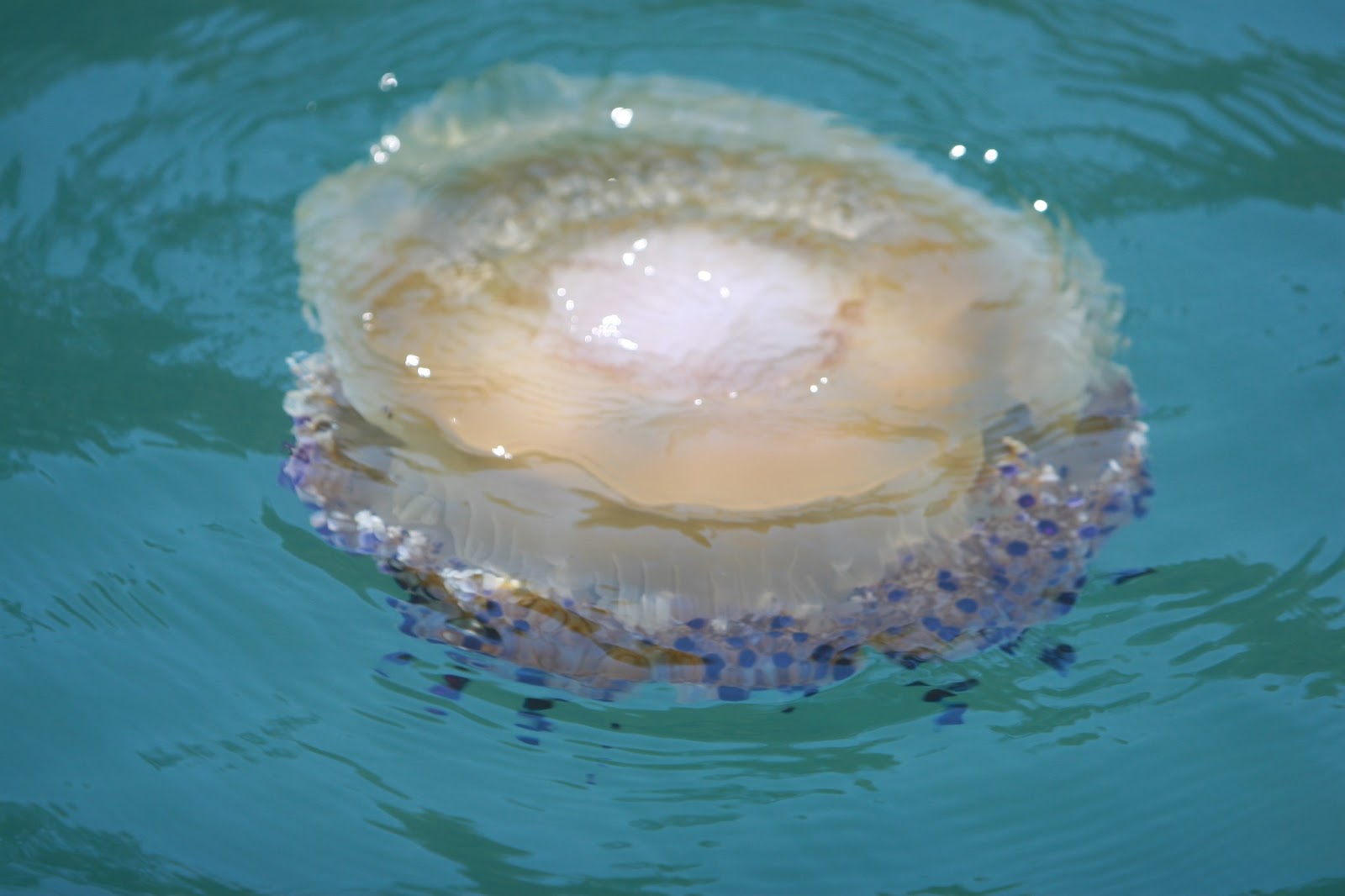
 
A fried-egg jelly, Cotylorhiza tuberculata.

Our best wildlife spot of all was Badem, a Mediterranean Monk Seal, one of the most endangered mammals in the world. Badem was found along the coast in December 2006 when she was 4-6 weeks old. She’d been separated from her mother, she was rescued and cared for by Underwater Research Society – Mditerranean Seal Research Group (SAD-AFAG, in its Turkish acronym). A local businessman, Mustaca Koç, and his family, covered most of the rehabilitation cost of the orphaned seal and have led efforts to ensure residents, boat crews and visitors help ensure the future of Badem and the remaining monk seals in the region. The Turkish Coast Guard and SAD-AFAG monitor Badem’s movements and try to minimize interactions between Badem and people so that she’ll more quickly adapt back to her natural way of life. Badem has other ideas.  She’s decided that people have better sleeping accommodations than rocky beaches and frequently jumps into the dinghies of anchored boats for her afternoon nap! She also likes to play with snorkelers. The boat crews help the protection efforts by letting their passengers know not to approach or try to touch Badem, she is, after all, a wild animal and will bite if threatened. But, she has no qualms in going for a ride as she showed us when we met her in Tuzla Bay where she was napping in a neighboring vessel’s dinghy. The captain rowed her over to our boat so we could ooh and aah and take pictures while she slept on. It’s illegal to approach her, touch her, feed her or harass her in any way, but she sure makes it difficult not to! (For more information on Badem, go to:  www.monachus-uardian.org/news/pdf/badem_brosur.pdf)

Badem, settling in for an afternoon nap.

All in all, we had a fantastic time and learned many valuable lessons. Todd won’t drink his bourbon starting at 9 a.m., Lynne won’t drink turkish coffee--ever, Matt won’t dance with Comhur, Ted will get a bigger lens, and Nadine and Donna will try to avoid men with big lenses! And we’d all HIGHLY recommend a blue cruise with Azure Odyssey to all of our friends!

This post first appeared on our European travels blog: http://madrobnik.wordpress.com/

Wednesday, July 11, 2012

THE WONDERFUL WORLD OF SEA JELLIES!


I love sea jellies (commonly referred to as jellyfish, although they aren't fish at all.) My infatuation with these graceful, mesmerizing invertebrates started when I saw what looked like a cross between a flower and an anemone on the sandy bottom of Brewer's Bay in St. Thomas. I'd recently transferred to the College of the Virgin Islands and was snorkeling around the school's dock. The flower was beautiful with its green-gold petals undulating with the slight surge. I had to get a closer look! (Casseopia photo courtesy of Shyzaboy's Flickr photostream.)


As I was about to touch a petal, a hand grabbed my wrist. My ecology professor was snorkeling nearby and saw what I was about to do. He pulled me to the surface and said, "That's not a plant, it's a jellyfish."

Now I was even more fascinated so found out everything I could about Cassiopea xamachana, the "upside-down jellyfish." Three years later, I did my senior research project and independent study on Cassiopea, and have never lost my fascination with jellies.

Maybe my affinity for these creatures comes from our many shared traits: elegance, grace, soft and pliable, yet able to defend ourselves with nasty barbs.

OK, we only share one out of those five traits. I'll let you guess which. Whatever the reason for my interest in these floating sacs of jelly, I'm drawn to them and endlessly curious about the incredible variety found within the phylum Cnidaria-from the Greek word for nettle, as in the stinging plant.

The Cnidarians are broken into three classes: scyphozoans (true jellies), anthozoans (corals and anemones), and hydrozoans (colonial hydras and the Portuguese Man-of-war, not a true jelly.) While corals, anemones, and hydras are all very cool, it's the scyphozoans that really captured my heart and mind. Here are the three that I find most interesting.

Cassiopea xamachana, the upside-down mangrove jelly. My first jelly. The species name xamachana means Jamaican, so you're right to guess this is a predominantly Caribbean species. Not to cast aspersions on Jamaicans or other islanders, but these jellies have some island attitude. "It's hot down in the Caribbean mehson, we ain' wastin' energy doin' all that movin' aroung!" Instead of swimming upright, bell-up, tentacles-down in traditional jelly fashion, these guys find a comfy spot on the sandy or muddy bottom of calm lagoons or bays and kick back, upside down.

They've not only found a lazy-man approach to swimming (that is, they rarely do), but to eating, too. Inside the mesoglea (jelly) of Cassiopea live thousands of zooxanthellae: tiny, single-celled algae (dinoflagellates). They're what give Cassiopea their green-gold color. These little guys do what all plants do--they photosynthesize, creating sugar (food) from sunlight and carbon dioxide, and release oxygen in the process. This jelly-mon gets part of its food and oxygen from them.

The algae don't provide all of the food the jellies need, so they do still have to eat some. Like other jellies, Cassiopea capture unsuspecting prey that swims into their waving tentacles and lappets by paralyzing them with stinging cells (nematocysts). They then move the food to their mouths. That's right. Mouths. Cassiopea don't have a single mouth in the middle of a ring of oral arms like the rest of the jellies, but instead have mouths at the ends of each branch of their manubrium (the fancy jellyfish word for stomach)!

Is it any wonder I became so intrigued with these guys?

The object of my next jelly-infatuation is a hefty, Mediterranean species.
Cotylorhiza tuberculata, the fried-egg jelly. I first saw fried-egg jellies while sailing in the Aegean. They're one of the most common species of jelly in the Mediterranean, Agean and Adriatic. Their bell has a flattened region along the margin and a yellow-orange dome in the center giving it the appearance of a large fried egg when viewed from above. Like Cassiopea, this jelly hosts symbiotic zooxanthellae, but instead of having them throughout their bodies, they house them in round appendages between and around their oral arms. The purple-blue zooxanthellae filled balls give Cotylorhiza a festive, dressed-to-party look.

Like all jellies, Cotylorhiza have nematocysts and do sting. Reports vary on its intensity and impact on humans, ranging from "very mild" to "not dangerous." There are many reports (and pictures) of people handling them, including one of a researcher putting one on his head like a hat to demonstrate how little danger they pose. Since venom strength can vary from one animal to the next, and sensitivity can vary from person to person, I wouldn't recommend this, but I'd also be the first one to jump in and touch one.

What's really fascinating about the fried-egg jellies is that they are active swimmers. While most jellies can control over their movement through the contraction of the bell, they aren't strong swimmers and the currents and wind do most of the work. When aggregations of jellyfish "swarm" in a harbor, it's usually less because they wanted to stop there and more because the current or wind put them there. Fried egg jellies, though, actively move back and forth across harbors to be in the sunlight, probably to keep their zooxanthellae happy and productive.

Click HERE to see a great you-tube video of the fried-egg jelly swimming.

My final favorite jelly is Cyanea capillata, the lion's mane jelly. This jelly isn't one of my favorites because of its physiology, behavior, or appearance, but out of empathy. People judge it harshly based on a widely circulated picture that uses perspective to make it appear to be something it isn't. Haven't we all been judged quickly or falsely based on appearance?

I like to say that perception is NOT reality unless it's correct, and MISperception is just plain wrong. In the case of Cyanea, the misperception is about its size. Yes, the lion's mane jelly is the largest sea jelly in the world, but based on the image shown here--one that periodically makes its way around the Internet--this thing is a MONSTER! Even if that man next to it is 6' tall, the jelly is still more than twice his length. That would make this behemoth a whopping 15' across.


The truth is, even though the lion's mane jelly is the largest scyphozoan in the world's oceans, it only grows to about 6.5 feet (or 8' by some reports). Its tentacles can extend as far as 50 feet (or 100', depending on the source). Yes, its tentacles sting. But the toxin is far from "the most potent species of jellyfish" as reported on the National Geographic website. That honor remains with the box jelly (aka cubomedusa or sea wasp), the most venomous animal in the world. More than 5500 deaths have been attributed to box jellies since people started keeping records of that sort of thing in 1884. Cyanea's sting is said to be painful, but it's rarely fatal.

The lion's mane jelly only reaches the maximum of its size range in cold, northern waters of the Arctic, northern boreal seas, and North Atlantic. In the Atlantic, it can be found as far south as Florida. It's abundant enough in South Carolina waters that the SCDNR has a listing for them on their "Marine Organisms of SC" website, where they're noted as considerably smaller than 6-8' in diameter, and having a far from potent sting:

"The bell, measuring 6-8 inches (emphasis added), is saucer-shaped with reddish-brown oral arms and eight clusters of tentacles hanging underneath. Cyanea are generally considered moderate stingers. Symptoms are similar to those of the moon jelly but, usually more intense. Pain is relatively mild and often described as burning rather than stinging."


At least this jellies' notoriety resulted in some small bit of fame for the maligned creatures. A Cyanea sea jelly was the murder weapon in the Sherlock Holmes mystery "The Adventure of the Lion's Mane." The victim must have been highly sensitive, though, since most swimmers who encounter this giant jelly survive to tell the story themselves.

To read more about these fascinating creatures, take a look at these resources:

The Cephalopod Page http://www.thecephalopodpage.org/MarineInvertebrateZoology/Cassiopeaxamachana.html

Gowell, E. (2004). Amazing Jellies: Jewels of the Sea. A New England Aquarium Book. Bunker Hill Publishing, Piermont, NH. 48 pp.

Humann, Paul (1992). Reef Creature Identification: Florida Caribbean Bahamas. New World Publications, Inc., Jacksonville, FL. 320 pp.

Malawi Cichlids http://www.malawicichlidhomepage.com/other/cotylorhiza_tuberculata.html

SCDNR http://www.dnr.sc.gov/marine/pub/seascience/jellyfi.html

Walla Walla University, Rosario Beach Marine Laboratory web site http://www.wallawalla.edu/academics/departments/biology/rosario/inverts/Cnidaria/Class-Scyphozoa/Order-Semaeostomeae/Family-Cyaneidae/Cyanea_capillata.html

Photos from:
National Geographic at http://ocean.nationalgeographic.com/ocean/photos/colossal-sea-creatures/

NOAA

Shyzaboy's photostream on Flickr at: http://www.flickr.com/photos/shyzaboy/2628679420/

SCDNR at http://www.dnr.sc.gov/marine/pub/seascience/jellyfi.html